
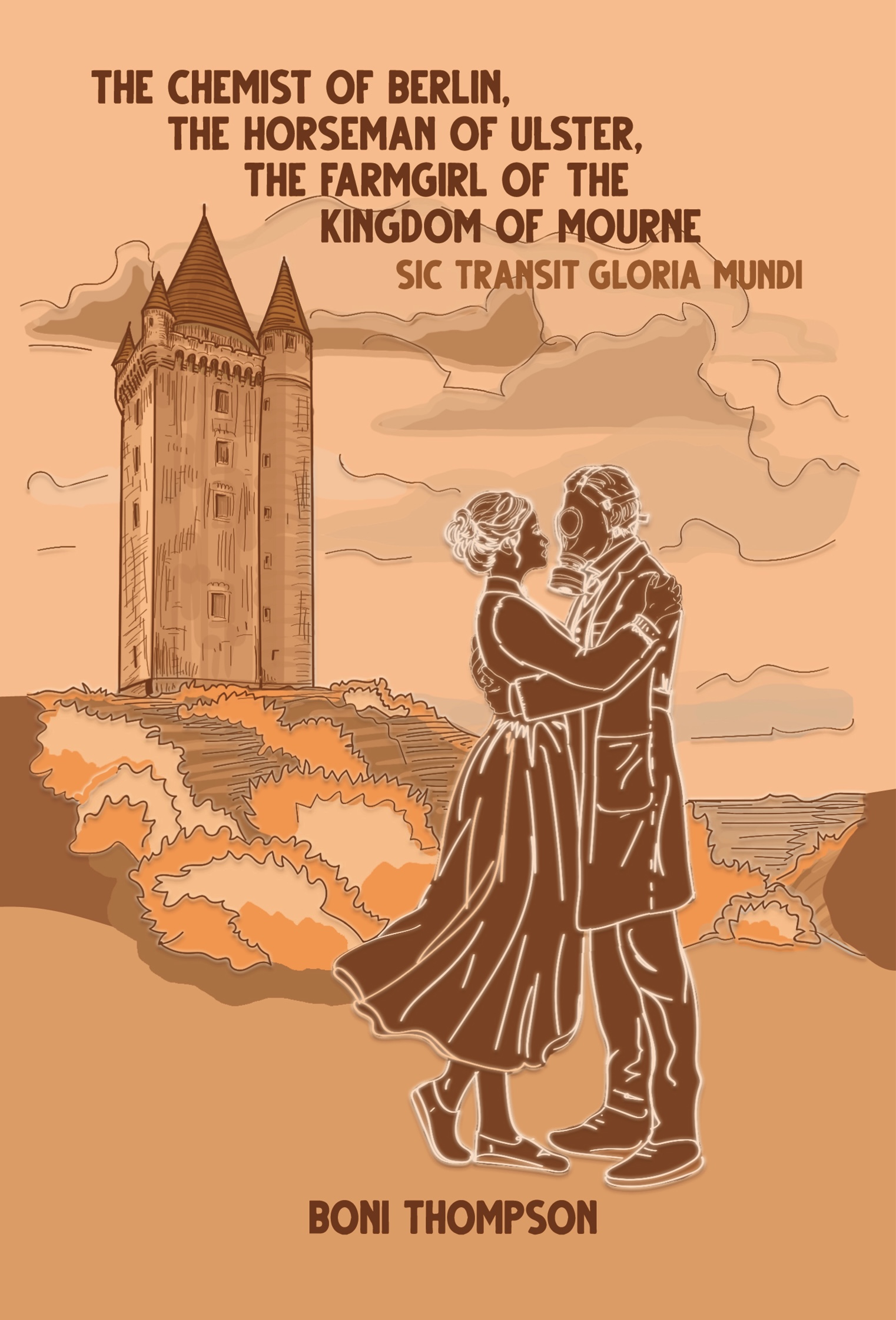
Boni Thompson’s latest book, The Chemist of Berlin, The Horseman of Ulster, The Farmgirl of the Kingdom of Mourne: Sic Transit Gloria Mundi is out June 23 2026.
This book, a creative non-fiction story of war, seems timely in its arrival. War and all of its horrors has made a comeback right in front of our faces. Not that it ever really went away, but for my generation, here in Canada, war was only to be found in books and stories, in far off places, rarely spoken of. Now, thanks to the technological wonders of our age, it follows us where ever we go. Attached to our watches, our screens, it slides in through our eyes. It slips into our ears through pods and talking heads, in the constant bombardment of disturbing, unwanted, uncontrollable information. All of it, or most of it. The people, the places, the madness, the destruction, the suffering. How quickly we can all be swept up under duress, closing one eye, finger in one ear, hoping and praying that it will all go away.
This story, the story of the chemists and the horseman and the farmgirl, begins with weapons of mass destruction. In fact, what is considered the very first weapon of mass destruction, poison gas. It is hard to think that we are still fighting such things. And not even the horror of them, but the simple idea of them. It leaves me wondering what right we have to walk the earth. And yet here we are.
The chemist, Fritz Haber—a genius in a rarified group of peers who would, almost to a man, win the Nobel prize one after another in chemistry or physics—is a man whose name has almost, although not quite, been scrubbed from history. Such is the disdain felt for him years after his nefarious invention. At the time, he was lauded as a mastermind. Prior to that he was elevated to the top of his peer group because of his work on fertilizer, a life-saver by any estimation. His good reputation was forgotten by many. The horror of his work in the war and the unspeakable suffering it precipitated is what he became known for.
The horseman, prancing happily on his beautiful horse, with all his horseman colleagues and friends do not think twice of joining up, signing on the dotted line, making their way to London and finally, to Ypres. He does not know the chemist, but he will suffer the effects of the chemist’s work.
The two women in the story live very different lives, both at first so happy: Clara to work with the great minds of the age, Ellen to find her place, her own home, her own family, yet both lives will be shattered because of the war.
Writing about your ancestors is so much more than writing the facts about one person’s lifespan. The task encapsulates a myriad of topics that must be investigated. Questions of why and how and what for jump up at every turn as you plod through extant documents, and photographs and records of every sort. After all, life in other times involved places, many almost unrecognizable now, and events that are difficult to understand in our own age, surrounded by characters who are long gone. It is a bit of a labyrinth trying to negotiate all manner of things, that have no place in the world we live in now.
There are, however, constants that remain whenever we speak of other humans, whether they be part of our own age, or any other century across the map of human history. And those are instantly recognizable. Love and hate, guilt and innocence, sorrow and contentment, all of these we know and understand and without even trying, these constants lead us into a deeper understanding of character than we might have at first assumed.
Fritz’s story draws us in as we feel his utter joy of discovery, his vindication after months and months of hard work in his lab. His later work will make us cringe and we will see the effects of pride and notoriety chipping away at Fritz’s initial hopes for mankind. Clara’s disappointment in her life is palpable as she begs her husband for changes he will not allow, her great tragedy as she is surrounded by despair and sees no way out. George’s desperation to live despite permanent injury, the thought of Ellen sustaining him, this too we can feel under the surface of our skin.
This is what connects us, the moments of their lives that are almost palpable to us a hundred years and more after the facts. It is the draw of creative nonfiction, to bring us not just into places and times we may not recognize, but into the minds of people, with all of their contradictions, the good and the bad, that we certainly do recognize and suddenly understand better than we thought we ever could.
The big question is can we learn something from those people of long ago? I say yes. If we can’t, then we are lost. Mark Twain tells us history does not repeat itself, but it does rhyme. And many others remind us that silence ensures that history will certainly repeat. At the very least we need to be grateful, not just for their great discoveries, their willingness to fight in a just cause, their quiet, unrelenting, unsung lives of raising families who end up being our ancestors and therefore a tiny part of us. Not just that, but their example of endurance, of fortitude, of hope in the future, of their willingness to try at all costs to move forward, to make their bits of the world a better place. And who benefits from all of this? We do of course. Knowing this, we in our turn, in our own bubbles of place and time, have an obligation to do likewise.

Leave a Reply