


In designing the maps for Arthur Conolly, Victorian Spy, cartographer Ana Mojica Myers faced a challenge: how to represent landscape features not as they are today, but as they appeared in Conolly’s time.
Modern cartographers rely on satellite images to accurately represent features, but they do not always depict the landscape that Conolly and his contemporaries observed. Although mountain ranges, deserts, and steppe may have changed little in the last two centuries, some rivers have changed course, and lakes changed in area, either because of flooding or irrigation for agriculture.
The most notable example is the Aral Sea. It was strategically significant: Conolly believed that a Russian army could use its fishing fleet to travel upstream on the Oxus (today the Amu Darya) to the kingdoms of Khiva and Bokhara, using them as a staging post for an invasion of British India.
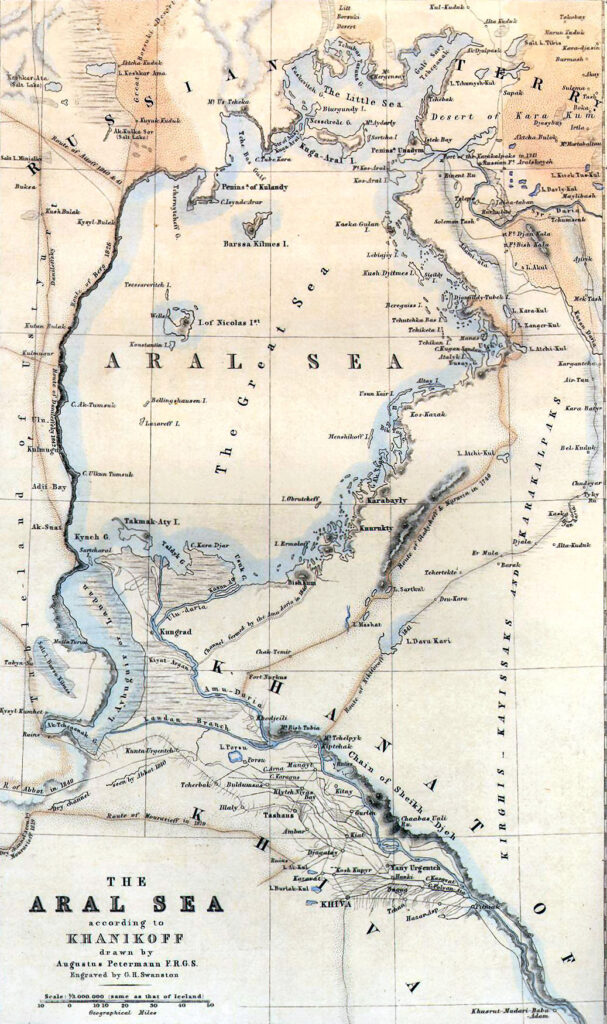
Today, the Aral Sea is estimated to be only 10 per cent of the size it was in Conolly’s era. From the 1960s, Soviet-era irrigation projects, mostly for cotton in what is present-day Uzbekistan, diverted water from the two major rivers—the Amu Darya and Syr Darya (Jaxartes)—creating one of the world’s great ecological disasters. The fishing fleet is no more.
What was the area of the Aral Sea in the 1840s? There are contemporary descriptions, but only a map can show its full expanse and for that we are indebted to the Russian traveller and surveyor, Nikolai Khanykov. He had travelled widely in Central Asia, spoke fluent Persian, and was a member of a geological and intelligence mission sent to Bokhara in 1841. Its leader, Lieutenant Colonel KonstantinButenev,attempted unsuccessfully to secure the release of Conolly and his fellow officer, Lieutenant Colonel Charles Stoddart, from imprisonment by the Emir of Bokhara, Nasrullah Khan.
On a later mission in 1851, Khanykov mapped the Aral Sea. Ana used this map to show its area, not as it appears in contemporary satellite images, but as it was in Conolly’s time.
Arthur Conolly, Victorian Spy is based on primary sources, including Conolly’s journals and letters. Order the paperback or e-book.
Leave a Reply