

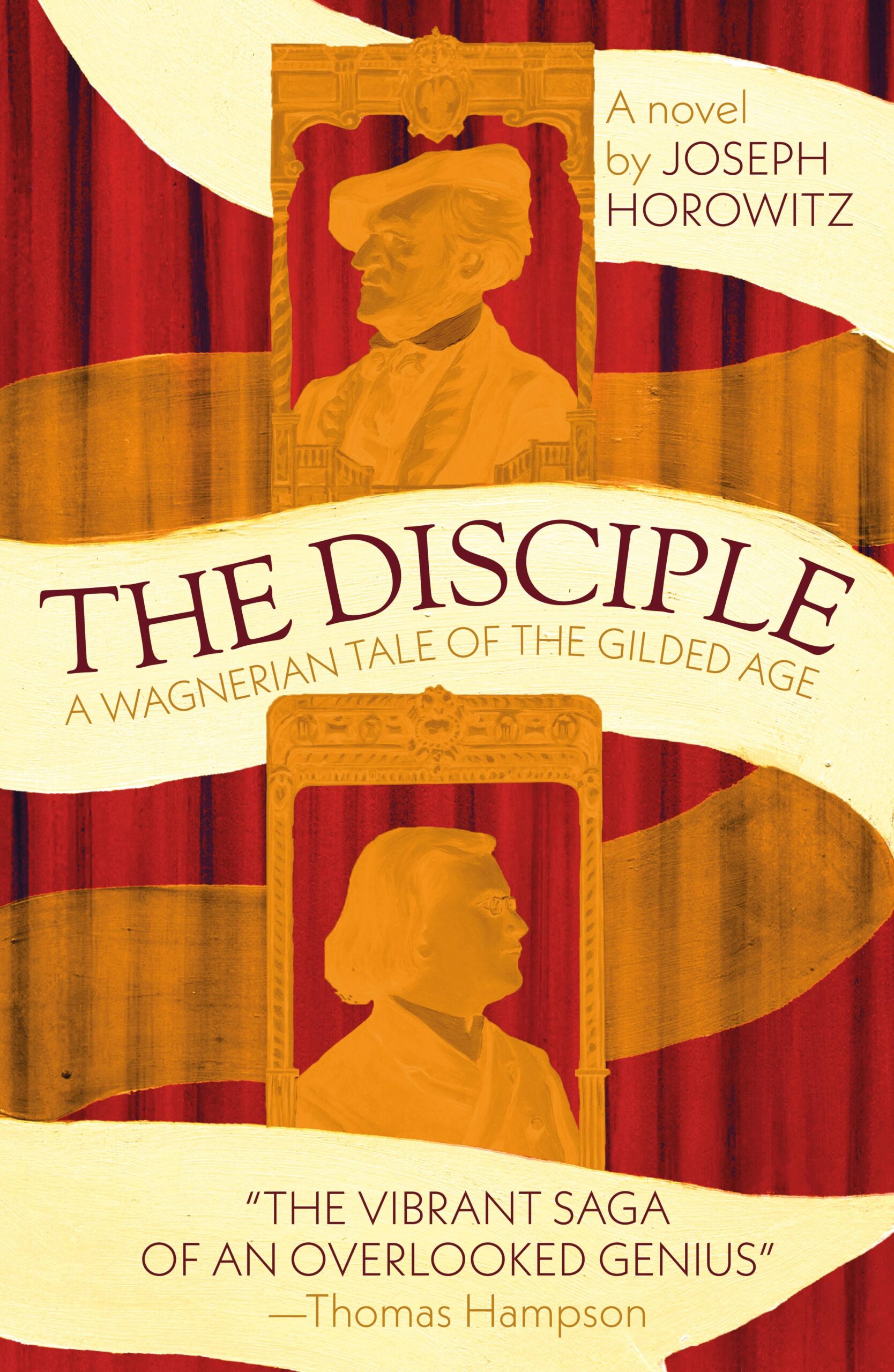
Before his death in 1898 at the age of 47, conductor Anton Seidl had given the us premieres of half of Wagner’s mature canon and the first performance of Dvořák’s New World Symphony. He was, as American composer, critic, lecturer and music publisher Arthur Farwell wrote, ‘famous alike for the depth of his silence and the height of his art’. Joseph Horowitz’s new novel The Disciple – in part a culmination of four decades’ scholarship – may justifiably inhabit the void of that silence while commemorating the height of that art.
Although his focus is on the musical world, Horowitz is as much a master literary conjurer of Gilded Age New York as Edith Wharton. His nonfiction books Wagner Nights (1994) and Moral Fire (2012) first awoke Seidl, the Tribune critic Henry Krehbiel and the Brooklyn impresario Laura Langford from their archival slumber.
In this historical novel and prequel to his 2023 Mahler novel The Marriage, he sets them vividly in motion with all the license fictionalized embellishment can afford.
Langford, the clairvoyant theosophist running women-only Wagner concerts at Brighton Beach is possibly the most arrestingly drawn of the three central characters. She was a self-mythologizing “new woman” with a concealed Tennessee past, who made 15-cent Wagner a populist sacrament, busing working women and Black orphans to the seaside pavilion.
It’s the musical set pieces which will register most. The Tristan und Isolde Prelude heaves and recedes poetically. Dvořák deflects Krehbiel’s nationalist catechism with a shrug – “You must not underestimate the musicianship of birds” – while the Largo of the New World [Symphony] is decoded as private Heimweh.
And Horowitz is so good at capturing the experience of witnessing a live performance: “The sweeping rise and fall of Seidl’s baton produced a tidal symphonic sequence, the string choir heaving and receding in waves of pain.”
An oceanic sorrow gripped 3,600 enslaved auditors. Krehbiel closed his eyes. The violins traced a dissipating ascent. The curtain rose. A lamenting English horn addressed the sonic void.
The Disciple successfully orchestrates a series of luminous tableaux—Wagner’s funeral cortège in Venice, the 1896 tidal wave that took the Brighton pavilion and Seidl’s own obsequies are standouts – into a suite that is both sweeping tone poem and paean to a gifted and passionate musician.
—Will Yeoman, Limelight (Australia), August 2026 [four stars]
The Disciple should be read by all those for whom Wagner’s music and ‘thinking’ might earlier have been considered off-limits.
—Richard Whitehouse, Arcana (July 21, 2026)
In 1994, . . . Joseph Horowitz published his fascinating Wagner Nights, an account of the life and times of the conductor Anton Seidl, who introduced Tristan und Isolde to America (Metropolitan Opera, 1886, among many other performances during those German-language seasons), led the extraordinary series of popular summer concerts (heavy on Wagner) at Brighton Beach, and inspired the foundation of the Seidl Society, a largely female organization of cult intensity in support of Seidl’s work and of Wagnerism in the U.S. It was Horowitz’s research in the Seidl Society archives at the Brooklyn Historical Society that restored this artistically vital but forgotten history, with its enticing Gilded Age background and cast of larger-than-life characters, to our cultural memory.
Now, Horowitz has fictionalized the story in the form of a novel, The Disciple, bringing the era and its people, from great artists, iconic critics, and society stars to the black children sponsored by the Society, to vivid life. . . . Chapter One tells the tale of that Tristan premiere, starring the veteran Wagner tenor Albert Niemann and the great Lilli Lehmann, seen through the eyes of one of the most authoritative of those critics, Henry Krehbiel, while Chapter Ten takes us briefly into a coaching session with Seidl and Jean de Reszke, as the latter prepared for the crowning challenge of his legendary career.
—Conrad L. Osborne, “Osborne on Opera: A Critical Blog,” April 10, 2026
Joseph Horowitz’s captivating novel of the Gilded Age comes alive through the story of Anton Seidl, an overlooked genius of the Richard Wagner school. In The Disciple, Horowitz weaves the vibrant world of American classical music at the dawn of the 20th century into a compelling narrative commanding in detail. He yet again challenges our mounting cultural amnesia.
—Thomas Hampson
Joseph Horowitz’s knowledge of the great Wagnerian conductor Anton Seidl—one of the most charismatic figures of the Gilded Age—is second to none. He also possesses a remarkable capacity to weave factual information into a compelling fictional narrative. I learned a lot about Seidl, about the social milieu that he seduced, and about the thrilling musical life that he dominated.
—Barry Millington, chief music critic for The London Evening Standard and editor of The Wagner Journal
The Disciple will astonish readers with its insights into an extraordinary but little-known American artistic epoch. The re-creation of Antonín Dvořák is absolutely magical—poetic, tender, funny, irresistible. It evinces Horowitz’s love for the man and his music, brought to life in the most fascinating and beautiful way.
—JoAnn Falletta, Music Director, the Buffalo Philharmonic Orchestra
For several decades now, Joseph Horowitz has been our Cicerone through the delightfully vibrant scenery of classical music in Gilded Age America. Such is his love for that almost forgotten chapter of our history that he felt moved to transpose his unmatched knowledge of the era to the more easily accessible plane of fiction. Much of the attractiveness and fascination of this novel rests on the charismatic and enigmatic figure of Anton Seidl, the Hungarian-born conductor who became Richard Wagner’s disciple and emissary to America. The Disciple moves dexterously among New York, Bayreuth, and Brooklyn, offering intriguing glimpses of a short-lived but memorable rendezvous of Wagnerism and Feminism. Those who love the cultural history of New York will come away from The Disciple both enriched and enlightened.
—Hans Rudolf Vaget, Shedd Professor of German Studies and Comparative Literature Emeritus, Smith College


Reviews
There are no reviews yet.