In designing the maps for Arthur Conolly, Victorian Spy, cartographer Ana Mojica Myers faced a challenge: how to represent landscape features not as they are today, but as they appeared in Conolly’s time.
Modern cartographers rely on satellite images to accurately represent features, but they do not always depict the landscape that Conolly and his contemporaries observed. Although mountain ranges, deserts, and steppe may have changed little in the last two centuries, some rivers have changed course, and lakes changed in area, either because of flooding or irrigation for agriculture.
The most notable example is the Aral Sea. It was strategically significant: Conolly believed that a Russian army could use its fishing fleet to travel upstream on the Oxus (today the Amu Darya) to the kingdoms of Khiva and Bokhara, using them as a staging post for an invasion of British India.
Today, the Aral Sea is estimated to be only 10 per cent of the size it was in Conolly’s era. From the 1960s, Soviet-era irrigation projects, mostly for cotton in what is present-day Uzbekistan, diverted water from the two major rivers—the Amu Darya and Syr Darya (Jaxartes)—creating one of the world’s great ecological disasters. The fishing fleet is no more.
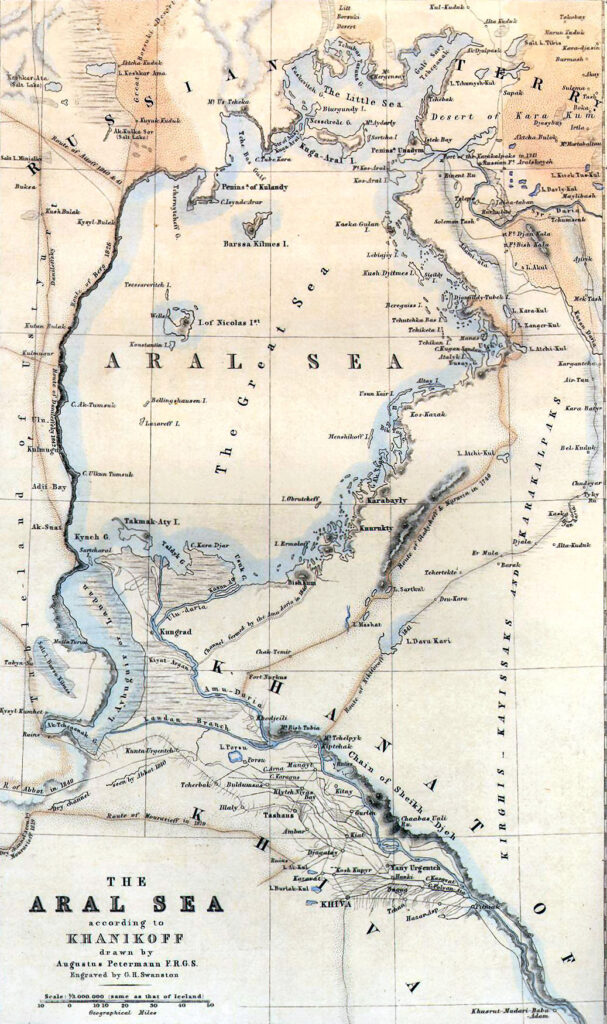
What was the area of the Aral Sea in the 1840s? There are contemporary descriptions, but only a map can show its full expanse and for that we are indebted to the Russian traveller and surveyor, Nikolai Khanykov. He had travelled widely in Central Asia, spoke fluent Persian, and was a member of a geological and intelligence mission sent to Bokhara in 1841. Its leader, Lieutenant Colonel KonstantinButenev,attempted unsuccessfully to secure the release of Conolly and his fellow officer, Lieutenant Colonel Charles Stoddart, from imprisonment by the Emir of Bokhara, Nasrullah Khan.
On a later mission in 1851, Khanykov mapped the Aral Sea. Ana used this map to show its area, not as it appears in contemporary satellite images, but as it was in Conolly’s time.
As we mark the 250th anniversary of the signing of the Declaration of Independence, Robert Ford shares why Cowpens was a pivotal battle in the American War of Independence, leading directly to the ultimate defeat of the British.
The Battle of Cowpens was a formative experience in a dawning America. The underdog in any calculation of the Revolutionary War, America had fought hard for four years with few wins anywhere and a string of disastrous losses in the south. Enter: Daniel Morgan, a rough son of the backcountry with a new idea. He would mass rifles on the front lines to maximize the weapon’s deadly accuracy against the British leadership. Stripped of its leaders, the well-disciplined British army would devolve into a mob, rudderless in the maelstrom of enemy volleys. His primary target: Banastre Tarleton, spoiled scion of British wealth, the most despised officer in North America, and the man we all love to hate. Tarleton, arrogant to a fault and convinced of his own abilities, charged headlong into Morgan’s carefully prepared lines and found only waves of disaster crashing on him and his army. The battle marked a turning point in the war. No longer luckless and winless, the Americans found new energy and a revitalized sense of self. It was a short step to the ultimate victory at Yorktown, a result unimaginable before Cowpens. In this season of America’s birthday, if you have an interest in the way America achieved its birth, you will be interested in this fascinating tale.
This book, a creative non-fiction story of war, seems timely in its arrival. War and all of its horrors has made a comeback right in front of our faces. Not that it ever really went away, but for my generation, here in Canada, war was only to be found in books and stories, in far off places, rarely spoken of. Now, thanks to the technological wonders of our age, it follows us where ever we go. Attached to our watches, our screens, it slides in through our eyes. It slips into our ears through pods and talking heads, in the constant bombardment of disturbing, unwanted, uncontrollable information. All of it, or most of it. The people, the places, the madness, the destruction, the suffering. How quickly we can all be swept up under duress, closing one eye, finger in one ear, hoping and praying that it will all go away.
This story, the story of the chemists and the horseman and the farmgirl, begins with weapons of mass destruction. In fact, what is considered the very first weapon of mass destruction, poison gas. It is hard to think that we are still fighting such things. And not even the horror of them, but the simple idea of them. It leaves me wondering what right we have to walk the earth. And yet here we are.
The chemist, Fritz Haber—a genius in a rarified group of peers who would, almost to a man, win the Nobel prize one after another in chemistry or physics—is a man whose name has almost, although not quite, been scrubbed from history. Such is the disdain felt for him years after his nefarious invention. At the time, he was lauded as a mastermind. Prior to that he was elevated to the top of his peer group because of his work on fertilizer, a life-saver by any estimation. His good reputation was forgotten by many. The horror of his work in the war and the unspeakable suffering it precipitated is what he became known for.
The horseman, prancing happily on his beautiful horse, with all his horseman colleagues and friends do not think twice of joining up, signing on the dotted line, making their way to London and finally, to Ypres. He does not know the chemist, but he will suffer the effects of the chemist’s work.
The two women in the story live very different lives, both at first so happy: Clara to work with the great minds of the age, Ellen to find her place, her own home, her own family, yet both lives will be shattered because of the war.
Writing about your ancestors is so much more than writing the facts about one person’s lifespan. The task encapsulates a myriad of topics that must be investigated. Questions of why and how and what for jump up at every turn as you plod through extant documents, and photographs and records of every sort. After all, life in other times involved places, many almost unrecognizable now, and events that are difficult to understand in our own age, surrounded by characters who are long gone. It is a bit of a labyrinth trying to negotiate all manner of things, that have no place in the world we live in now.
There are, however, constants that remain whenever we speak of other humans, whether they be part of our own age, or any other century across the map of human history. And those are instantly recognizable. Love and hate, guilt and innocence, sorrow and contentment, all of these we know and understand and without even trying, these constants lead us into a deeper understanding of character than we might have at first assumed.
Fritz’s story draws us in as we feel his utter joy of discovery, his vindication after months and months of hard work in his lab. His later work will make us cringe and we will see the effects of pride and notoriety chipping away at Fritz’s initial hopes for mankind. Clara’s disappointment in her life is palpable as she begs her husband for changes he will not allow, her great tragedy as she is surrounded by despair and sees no way out. George’s desperation to live despite permanent injury, the thought of Ellen sustaining him, this too we can feel under the surface of our skin.
This is what connects us, the moments of their lives that are almost palpable to us a hundred years and more after the facts. It is the draw of creative nonfiction, to bring us not just into places and times we may not recognize, but into the minds of people, with all of their contradictions, the good and the bad, that we certainly do recognize and suddenly understand better than we thought we ever could.
The big question is can we learn something from those people of long ago? I say yes. If we can’t, then we are lost. Mark Twain tells us history does not repeat itself, but it does rhyme. And many others remind us that silence ensures that history will certainly repeat. At the very least we need to be grateful, not just for their great discoveries, their willingness to fight in a just cause, their quiet, unrelenting, unsung lives of raising families who end up being our ancestors and therefore a tiny part of us. Not just that, but their example of endurance, of fortitude, of hope in the future, of their willingness to try at all costs to move forward, to make their bits of the world a better place. And who benefits from all of this? We do of course. Knowing this, we in our turn, in our own bubbles of place and time, have an obligation to do likewise.
We’re delighted to announce the next five titles from Blackwater Press. Spanning the battlefields of the First World War, the forests of an imagined world, Victorian Central Asia, and the Alaskan wilderness, these forthcoming books showcase the breadth and diversity of our publishing programme.
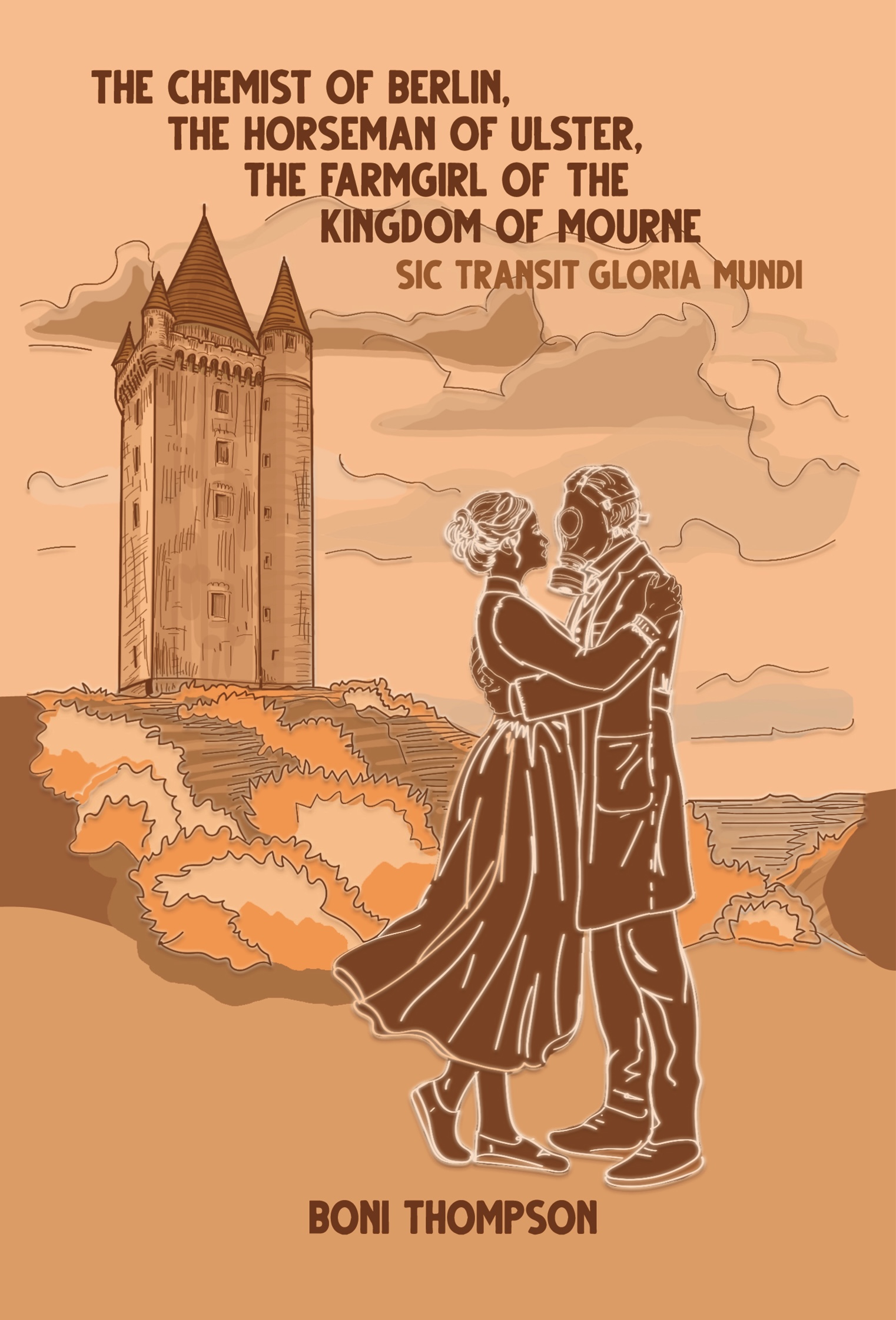
Drawing on scholarly research, family history, letters, and photographs, Boni Thompson brings together the lives of Clara Immerwahr, wife of the chemist Fritz Haber, Ulster horseman George McGivern, and farmgirl Ellen Rogers. Their intertwined stories reveal how the First World War shaped both the celebrated figures of history and the ordinary people caught in its wake.
When Peter is sent to capture a child unlike any he has ever encountered, he embarks on a perilous journey alongside the mysterious “bird child” and his companion Jamie. Inspired by Hugo Simberg’s The Wounded Angel and the Venezuelan crisis and diaspora, this haunting literary novel explores belonging, difference, and the powerful allure of charismatic leaders.
As Britain and Russia vie for influence across Central Asia in the 1840s, East India Company officer Arthur Conolly undertakes a dangerous mission to forge alliances, expand trade, and combat slavery. David H. Mould recounts the extraordinary life of one of the most fascinating figures of the Great Game.
In 1991, a young writer disappears after participating in a secretive year-long drug trial. More than two decades later, a cache of documents and the discovery of an abandoned research facility begin to reveal what really happened. Told through found documents and personal narrative, Eric Percak’s novel is a compelling literary mystery about ambition, discovery, and the limits of human experimentation.
From Iceland to Minnesota, from the Italian Dolomites to the beaches of Spain, Leah Rogin’s debut collection takes readers around the world through the eyes of travellers, dreamers, outsiders, and seekers. By turns funny, poignant, and sharply observed, these stories explore friendship, identity, loneliness, belonging, and the complicated freedoms of movement in a world that remains beautiful. At least for now.
Thank you, as always, for supporting independent publishing and the authors whose work makes it possible. We look forward to sharing these remarkable books with you in the months ahead.
Drawing on unprecedented access to family records, Boucher brings to light the tragic and compelling story of a woman history all but forgot. Elizabeth’s life reflects the fate of so many women of the past: married young, denied agency, and left with little voice in shaping her own future. As her mental state deteriorated, she was declared “mad” and died in obscurity, effectively erased from history by her own family.
This remarkable biography not only restores Elizabeth to her rightful place in the historical record, but also raises urgent questions about the nature of “madness” in a world where women were denied even the most basic autonomy.
For readers drawn to women’s history, British history, scandal, and the untold stories of the past, this is a book not to miss — a story so extraordinary it seems almost unbelievable, yet every word is true.
We have two pieces of good news to share this month.
Editorial Services Are Back
Our Blackwater Press Editorial Services are now available again.
If your manuscript would benefit from professional editing before submission, or if you’re planning to self-publish and want expert guidance, we’re here to help.
Once again Flòraidh MacDonald Ford has agreed to take our questions for Answer Your Cat’s Questions Day. She joins us from her heated stool in Elizabeth’s home office. Please read our previous interviews with her here and here.
Good morning Flòraidh, and thank you for joining us again this year.
Good morning, and thank you for having me. We have a lot of catching up to do!
So we do; let’s get started. And this year we have some questions from your internet public as well.
(Rolls over, shows belly).
Current body count:
44. When I get to 50 our lawyer said he’d buy me a steak. It’s good to have a goal.
Caused any chaos this year?
I think that depends on how you define “chaos.” But a few events stick out. One morning I wanted mommy to get up so I leapt to the top of the dresser and knocked over a full vase of flowers. It was a mess! Another morning, she didn’t get up immediately when I meowed, so I jumped up and clawed her head and the pillow and then stood on her throat and howled. Now I have to spend the night in the basement.
Did you learn anything from this?
Me? No, but mommy should have learned that it could have all been avoided if she’d just get up at 4 a.m. Oh, there was also the time I knocked over a full glass of red wine onto white carpet… After engaging in several rounds of chemical warfare mommy had to borrow a steamer…
(Stretches long with tummy exposed. Pulls front feet up to resemble a bunny).
What do you think of your sisters, Sally and Lucy?
Well, they’re dogs. So far as dogs go, they’re alright. I like to bat their tails and sometimes I take a swipe at Lucy just because I can. Sally found me, so I try to be nice to her, but I love lying against the kitchen heat duct and making the door move and trapping her in the hall. I could do that all day! (Submitted by Kaaren Ford).
Do you know when Blackwater’s submissions will reopen?
Soon. I’m ready to roll on a few new books. And I’ve discovered I really like sitting on the keyboard of the computer! Almost as nice as my heated bed.
What’s the nicest thing you did this year?
I sent some food and treats I don’t like to less advantaged cats. I also picked out a new collar from Made By Cleo for a kitten who is soon to be welcomed into his new home. He looks like me, but fluffy. I even had it gift-wrapped! (Submitted by Samantha Stafford).
Do you have any advice for Elizabeth in the coming year?
Yes. Get up earlier. Don’t talk when I’m having laptime. Childless cat ladies are still the best but there’s always room for improvement and personal growth. (Submitted by Samantha Stafford).
What are you saying when you howl?
Is ann aìr a shon fhèin an ni an cat crònan.
Flora, to what do you owe your keen litter-rary sensibilities? Parental influence? Innate talent? And what is your favorite time of day to review manuscripts? Any “pet” peeves we authors should avoid? Thank you.
Thank you for this question. I think parental influence has a lot to do with it: the night Sally found me and I got to go home I flopped down on the manuscript of Ma Chère Maman. The Flounder and Ballad of Cherrystoke soon followed. I think being read to as a kitten made a big difference so now I can judge quality. I’m always on call for reviewing a manuscript: if the papers are out, I’m ready to flop (or not). I think it’s well-known that we don’t accept any manuscript in an animal is lost or killed. Avoid that and avoid comparing yourselves to Hemingway in the cover email, don’t send a manuscript with the tracking turned on, and use full sentences. And please, no dragons. (Submitted by Sheila McEntee).
Do you have any predictions for 2026?
I’d like to see some more submissions in our Recollections series, and I’d be especially keen on manuscripts related to Flora MacDonald or other women of her time and place. I hope I get even more time to snuggle and knock things over and eventually stop having to sleep in the basement.
If you were a book, which book would you be?
That’s a really hard question. I like a book to be long and engrossing enough that I can get a good snuggle in while reading it, but not so long that the book is too heavy to be held up, and it has to rest on me. I also really enjoy the Jenny and the Cat Clubseries by Esther Averill. (Submitted by Vivien Williams).
What’s your favourite bird?
I have two bird feeders in front of my house, so I spend a lot of time running from window to window to monitor. I like cardinals, and starlings are interesting too.
Do you believe in international law, or can a small country be taken by force?
Thank you for this question. Given historical precedents, especially from the eighteenth century, it’s how nations were built, but it doesn’t always work out. I can think of a few notable examples that ended in ignominious and crushing defeat for the invading force. But if I were an outside cat, I would want to annex the neighbour’s yard, and no one will tell me I can’t do it.
Do you always look grumpy or did something bad happen just now?
If you’re referring to the picture Flora et Florae in the post, mommy had just told me to stop eating that African violet and just because my name means flower doesn’t mean I can eat them. It’s an ongoing debate we have. And I win because that violet has my teeth marks on it now.
You like to brag about your “body count.” What is it you kill…and what do you do with the bodies?
Rodents, primarily. Bugs and lizards are also included in the total. I like to show mommy, but she doesn’t like that. Sometimes there’s a burial at sea. I’m also known as the Angel of Death. (Submitted by Samantha Stafford).
How do you really feel about living in Kentucky?
Um, well, I don’t get as carsick anymore, but otherwise it’s not that different routine-wise. I don’t see as many other animals from the windows, so it isn’t as interesting as West Virginia., and nothing compares to the Yurt. (Submitted by Jenny Totten). (Folds in half, licks behind).
Flora, do you go outside? And if you do, what are your activities there?
I’m a housecat but I love fresh air, so when the weather is suitable, I take the air in a large dog crate on the back porch. I sniff, meow, and sometimes my lizard friend stops by. (Submitted by Susan Weisser).
Do you prefer the English or the Gaelic spelling of your name?
Gaelic, but I answer to both.
Anything else you’d like to add?
Tha iongantas air a chat earball a bhi aìr.
(Launches self at Christmas tree scratching post trunk, chasing tail while going in a circle around it with her toy unicorn in her mouth).
I think we’ll leave it there! Until next year, Flòraidh~!
As we start 2026, we are delighted to announce our titles for this year.
The Disciple: A Wagnerian Tale for the Gilded Age by Joseph Horowitz
Anton Seidl arrived in New York in 1885, three years following the death of his mentor Richard Wagner. He became a major influence in the cultural taste of late nineteenth-century New York, which was dominated by Wagner’s opera. With the help of Laura Langford and the Seidl Society, he became the most important impresario in Brooklyn, before his early death in 1898.
The Disciple is a must-read for any fans of historic fiction, Gilded Age New York, and opera. It is the prequel to Horowitz’s acclaimed first novel The Marriage: The Mahlers in New York.
Rory’s Not That Guy and Other Tales from Middle America by William E. Burleson
Rory’s Not That Guy: And Other Tales from Middle America takes the reader on a tour of “flyover country,” from struggling small towns to honky-tonks to the parts of cities that don’t make it onto postcards.
This collection of 19 short stories, many humorous, many not, includes coming of age in a hopeless small town (“Art”), what if you could go back in time and go to high school again (“No Returns”), and what happens when your carefully arranged world is disrupted by civil unrest (“Willie Wallace”). Fifteen of the nineteen stories have been published in a variety of literary magazines and anthologies, including The New Guard, Evening Street Press & Review, and American Fiction.
An Absent Life: Elizabeth, the ‘Mad’ Duchess of Albemarle, 1654-1734 by Paul Boucher
The first-ever biography of the so-called “mad duchess,” Elizabeth Albemarle, this book is rich in period detail because of the unprecedented access of its author to the archives in her ancestral home of Boughton House. A must-read for anyone interested in women’s history in the seventeenth and eighteenth centuries from the austerity of the Cromwellian period through the splendors of Restoration. The second in our Recollections…The Long Eighteenth Century series.
The Chemist of Berlin, The Horseman of Ulster, The Farmgirl of the Kingdom of Mourne by Boni Thompson
Poison gas.
Clara Immerwahr, wife of its famed inventor, Fritz Haber.
George McGivern, an Ulsterman and horse breeder/farrier who joins the Horse Guards and suffers its effects.
Ellen Rogers, his wife, a farmgirl and domestic servant from the Mountains of Mourne.
Their stories demonstrate how war affects both the great minds of the age as well as the most ordinary of lives. The story has been based on scholarly research, family history, information from local historians, as well as letters and photographs of the main characters.
The Wounded Me by Sherezade García Rangel
When the child he is supposed to capture is unlike anything he has ever seen—or been trained to expect—Peter must decide whether to go back empty handed or to accept Jamie’s pleas and take a chance on the fascinating yet unfathomable “bird child.” A perilous journey awaits the unusual trio who must rush away from the outskirts of the feared town of Belua and elude its inhabitants across an ancient forest and up remote mountains, or risk being spotted and hunted by them.
Will the journey help them discover more about the bird child?
Will they be welcomed back into HomeVillage, where the true brothers expect a familiar captured child just like them?
Will the bird child finish breaking the close bond that used to exist between Peter and Jaime?
A literary and haunting novel which explores our captivation with charismatic leaders and our discomfort with difference. Borrowing the central characters from Hugo Simberg’s cryptic painting The Wounded Angel and mobilising them in an allegorical tale inspired by the Venezuelan crisis and diaspora, this story of adventure, brotherhood and desperation asks: why do we follow our leaders and what are we willing to do to belong?
Arthur Connolly: Victorian Spy by David H. Mould
In September 1840, Captain Arthur Conolly, an intelligence officer in the East India Company, set out from Afghanistan’s capital, Kabul, recently captured by a British army, for Central Asia. His orders were to assess the military capacity of the kingdoms of Khiva, Kokand and Bokhara, and persuade their rulers to unite to resist Russian advances and open their markets to British goods. Conolly, a devout Christian and abolitionist, had a higher agenda: to free thousands of slaves and pave the way for missionaries.
What About the Scientists? by Eric Percak
In 1991, a reckless experiment pushes a young writer, Lily, to flee and take her chances in the Alaskan wilderness. She is never heard from again. Twenty-six years later, a hiker stumbles upon a cache of documents buried in the bush which relate Lily’s account of a revolutionary drug trial in which she had agreed to be sequestered for one year. While the story’s authenticity is questionable at first, when an abandoned research facility is discovered nearby, the truth comes into focus.
Once again, we have a variety of new talent and old friends among our authors, and we hope there’s something here for you to enjoy.
And… we know the turn of year often means more time to read, and that (like us!) you may have already made it through the pile of books you received for Christmas. Now through January 13, we are offering 25% off all titles plus free shipping with code SALE25 at checkout.
“Should you call me Maestra? God, no. That’s as bad as poetess.”
The speaker is Hannah Schaeffer, the musical protagonist of The Maestro and Her Protégé, at the pinnacle of her conducting career. Hannah was just 10 years old, though still pretty sure of herself, when she showed up one early morning in the 1990s, refusing to stay in the background of a novel I’d just started writing. A month or two later, this strong-willed character headed off to Paris to study with Nadia Boulanger.
I’d never been to Paris, but I did know something about Mademoiselle Boulanger. A musical master, she was a teacher to almost any 20th century American composer you can name—Aaron Copeland, Philip Glass, Elliot Carter, Quincy Jones; the list goes on. And through her American Conservatory in Fontainebleau, she influenced generations of musicians and music educators you might not be able to name, including my freshman-year music theory professor. Whenever he mentioned his studies with Boulanger, his tone was reverent—but there was also something else I could hear. Something that reminded me of the way I felt right before a dreaded theory “individual” with Dr. Hartzell. Something that made me pay attention.
Born in 1887, Boulanger was the first woman to guest-conduct the New York Philharmonic—in 1938—the same year she broke the gender barrier with the Boston Symphony Orchestra. (It wasn’t until 2007 that another woman took the podium at Symphony Hall.) A colleague of Fauré, a friend to Stravinsky, a mentor to Leonard Bernstein, Nadia Boulanger was an indisputable genius. As a teacher, she was known to be strict, unyielding, severe, and unapologetic. And she stopped teaching only weeks before she died in October 1979.
It was about sixteen years after Boulanger’s death that her imaginary student began to inhabit my pages. For the next few years, I followed Hannah around, listening, and also accumulating a serious reference collection to help out with all the historical and musical figures that were a part of her story. When an unrelated project took me to Paris, I hiked across town and up the hill to the cemetery where I knew Nadia Boulanger was buried. I can’t say why I started there; I’m not a grave-visitor by nature, and I could have located her apartment on Rue Ballu or visited Trinité, the church she attended every Sunday. But I headed to Division 33 at Cimetière Montmartre.
The tomb of Famille Boulanger hosts a coffin-shaped garden and a gray-white stone that rises up like a gothic window, sculpted with trailing flowers, etched with three generations of Boulangers, and worn by the work of guarding souls. That morning, I found a black and white photo hidden in the unruly groundcover that had overtaken the garden trough. A page cut out from a book, I was pretty sure, it had been slipped into a double-sided Lucite sleeve, edges scotch-taped against the elements. Another surprise: a single long-stemmed red rose soaking in a white marble vase. I touched the rose, not yet open, and I picked up the photograph. Mademoiselle, as she was known to her students, was seated at a grand piano, unsmiling, and, it seemed, looking straight at me.
Right then, I started to cry. Not little weepy-in-the-eyes-squint-back-tears kind of crying, but the uncontrollable, thank-God-I-have-a-Kleenex kind of sobbing. I felt bereft, inconsolable. Not to mention: puzzled. I sat down on the flat gravestone next to the Boulanger family tomb, blowing my nose, sipping from my water bottle, grateful that Division 33 was otherwise unoccupied.
Collecting myself, I understood something more about the people on my pages. Hannah, I realized, had grown up to be a remarkable woman—possibly breaking through a glass ceiling that Boulanger could barely see in the distance. I sensed that Hannah had paid a price for her prodigious talent and musical success. And I was beyond certain that she missed Mademoiselle. Because even though we’d never met, I missed her too.
For the next several years, whenever frequent flyer points and my day job allowed, I returned to Paris, borrowing an apartment in Boulanger’s neighborhood. I visited her grave, rehabilitated the garden, replaced the photograph every six or nine months, and delivered fresh flowers to the heavy vase. I took to feeding the cemetery cats and got to know some of the other cat-feeders who made their way into the book. Graveside, I met a handful of Mademoiselle’s students who came to pay their respects, and I was accepted into the fold, the student of a student.
Was I Kate or Hannah as I haunted the 9th arrondisement, stopping by Boulanger’s apartment building, picking up buttery croissants at a nearby bakery, and shopping in the little grocery at the end of her street? It was a kind of “Method” writing that I loved, but alas, real life was also filled with stories that needed sharing. Two memoirs later, I felt the novel still tugging at me. Hannah and Nadia, persistent and not exactly patient, made new requests. In service of their story, I walked across the stage at the Dorothy Chandler Pavilion in Los Angeles, and visited the green room in Lincoln Center. I attended open rehearsals of the Boston Symphony Orchestra, and was introduced to Philip Glass, who turned down my impromptu invitation to spend a winter afternoon remembering Mademoiselle. I’ve soaked in the neighborhood surrounding Carnegie Hall, and scoured the auction catalogue detailing the contents of Leonard Bernstein’s Manhattan apartment. I’ve read a lot of books. I’ve met Hannah’s parents, her grandmother, her kindly quintet coach (perhaps my favorite character in the novel), her first love, her best friend, her fire-starting student, and the Paris detective who annoys her at first sight. I’ve thought a lot about how it might feel to be an absurdly talented and ambitious woman in a profession (still) profoundly dominated by men. And thanks to Hannah and Nadia, I’ve visited a world where glass ceilings can be shattered, a world where dedication and determination matter, a world where the sky is visible, a world where a million kinds of love transcend the routine inconvenience of death. I invite you to join me there. We’ll be in great company.
Here is a story of foreignness, identity, and the leap into the unknown.
Blackwater Press is delighted to announce the launch of Running on Rooftops, by Andrea L. Stout, a poignant fictional memoir exploring what it means to step beyond one’s borders—geographical, emotional, and personal.
Anne Henry knows next to nothing about China—and even less about teaching. But when she accepts a one-year position at a Yinchuan English school, she finds herself navigating clashing worldviews, discovering friendship amid cultural collision, and confronting what it means to belong. From the dunes of the Gobi Desert to the dizzying heights of Mount Everest, Anne’s journey is a meditation on curiosity, connection, and courage.
With prose both vivid and tender, Stout captures the contradictions of being young and foreign—the beauty, the chaos, and the quiet heartbreak. As author Kate Mueser notes, “It’s a book for all humans, one that will inevitably leave you changed.”
About the Author Andrea L. Stout is an American writer and university lecturer in literature, writing, and storytelling. She has spent more than two decades living and working abroad across Asia, Europe, and North Africa—experiences that deeply inform her reflections on foreignness, identity, and place.